Email Configuration
You can configure the email that is being sent in your airflow.cfg
by setting a subject_template and/or a html_content_template
in the [email] section.
[email]
email_backend = airflow.utils.email.send_email_smtp
subject_template = /path/to/my_subject_template_file
html_content_template = /path/to/my_html_content_template_file
Equivalent environment variables look like:
AIRFLOW__EMAIL__EMAIL_BACKEND=airflow.utils.email.send_email_smtp
AIRFLOW__EMAIL__SUBJECT_TEMPLATE=/path/to/my_subject_template_file
AIRFLOW__EMAIL__HTML_CONTENT_TEMPLATE=/path/to/my_html_content_template_file
You can configure a sender’s email address by setting from_email in the [email] section like:
[email]
from_email = "John Doe <johndoe@example.com>"
Equivalent environment variables look like:
AIRFLOW__EMAIL__FROM_EMAIL="John Doe <johndoe@example.com>"
By default, email_backend is set to airflow.utils.email.send_email_smtp, which sends email over SMTP.
To configure SMTP settings, checkout the SMTP section in the standard configuration.
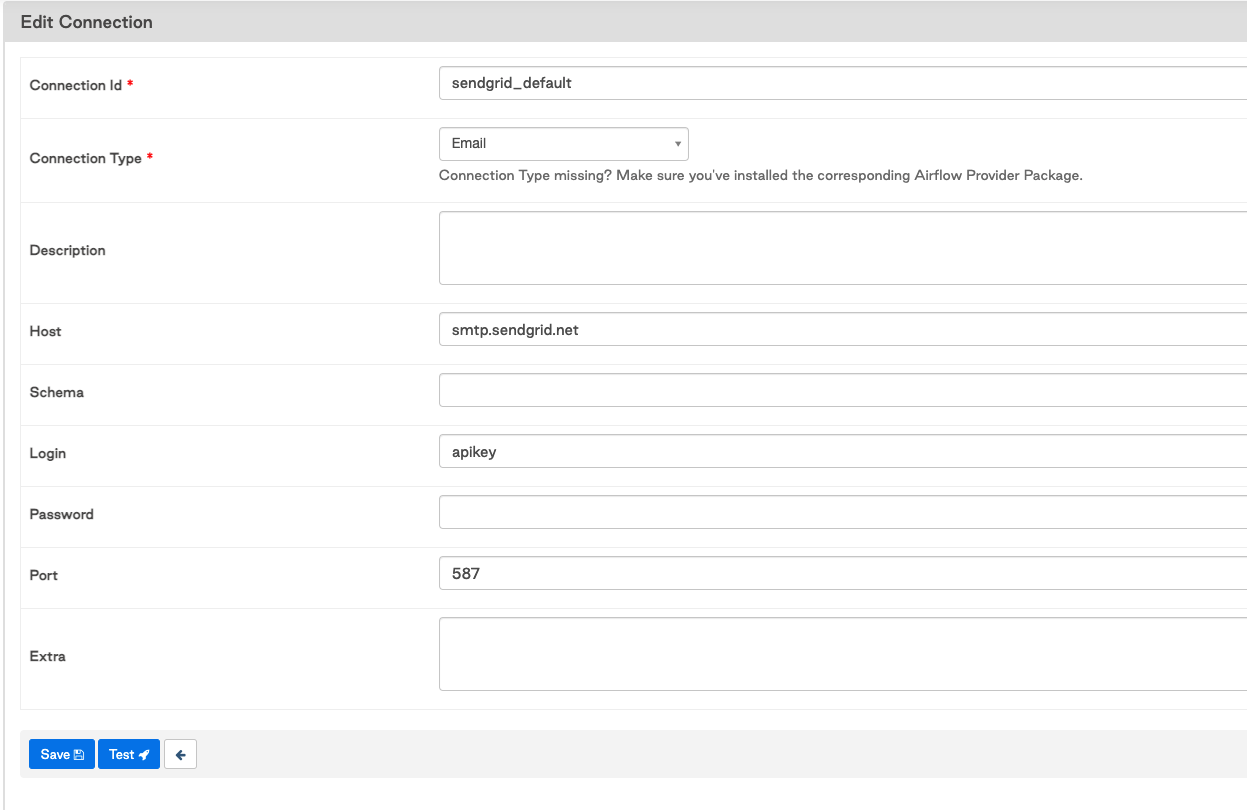
If you do not want to store the SMTP credentials in the config or in the environment variables, you can create a
connection called smtp_default of Email type, or choose a custom connection name and set the email_conn_id with its name in
the configuration & store SMTP username-password in it. Other SMTP settings like host, port etc always gets picked up
from the configuration only. The connection can be of any type (for example ‘HTTP connection’).
If you want to check which email backend is currently set, you can use airflow config get-value email email_backend command as in
the example below.
$ airflow config get-value email email_backend
airflow.utils.email.send_email_smtp
To access the task’s information you use Jinja Templating in your template files.
For example a html_content_template file could look like this:
Try {{try_number}} out of {{max_tries + 1}}<br>
Exception:<br>{{exception_html}}<br>
Log: <a href="{{ti.log_url}}">Link</a><br>
Host: {{ti.hostname}}<br>
Mark success: <a href="{{ti.mark_success_url}}">Link</a><br>
Note
For more information on setting the configuration, see Setting Configuration Options
Alternative email backends
Instead of sending email over SMTP, you can point email_backend at an implementation provided by a
community provider to send email through a third-party service’s API. To use one, install the relevant
provider distribution, set email_backend to the dotted path of its send_email function, and set
email_conn_id to a connection holding the credentials it needs.
The list of email backends provided by community-managed providers is available in Email backends.